Imagine you’re building your ultimate cricket team or assembling a top-tier gaming squad. You wouldn’t pick eleven aggressive strikers or eleven defensive players, right? You need a solid balance to win the tournament.
Investing in the indian stock market works the exact same way. When you invest, you are putting your money into different “players“—like stocks, bonds, mutual funds, and etfs—so your savings grow faster than inflation over time.
Whether you are 12 years old, in your 20s, or planning for your parents’ retirement, the game plan depends on two big things: your age and your risk tolerance. Let’s break down how this works in a simple, fun, and smart way!
- Asset Diversity: Balance your portfolio like a sports team using Stocks, Mutual Funds, ETFs, Index Funds, Bonds, and REITs.
- 100 – Age Rule: A simple formula to decide equity exposure (e.g., at age 25, keep ~75% in equity).
- SIP Power: Start small (even ₹500/month) with Systematic Investment Plans to benefit from Rupee Cost Averaging.
- Mindset over Hype: Avoid chasing social media tips, use stock screeners, and focus on long-term wealth compounding.
Investment Guide: Definitions You Must Know
Before picking a strategy, let’s introduce the key investment vehicles you’ll hear about on stock market websites and financial news channels.
What are Stocks (Direct Equity)
When you buy stocks (also known as buying shares in the share market), you own a tiny piece of a real company. If the company does well, your share price goes up. If it struggles, the value falls. Checking the stock market today or monitoring shares to buy today lets you see how much individual company pieces cost on a stock exchange like the NSE or BSE.
What is Mutual Fund
Imagine you and your friends pool money together to buy a giant box of 100 different chocolates. A professional manager picks the best mix for you. That is a mutual fund investment. Instead of picking individual shares to buy today, a mutual fund lets you own a diversified basket managed by experts from houses like nippon india mutual fund or dsp mutual fund.

What is ETF (Exchange Traded Fund)
ETFs are like a mashup between a stock and a mutual fund. They hold a basket of assets (like index stocks, gold, or tech), but you can trade them instantly during market hours on a best trading platform in india. You can buy a gold etf, a silver etf, a semiconductor etf, a lithium etf, or a copper etf depending on what industry you believe in!
What is Index Fund
An index fund simply copies a market benchmark like the Nifty 50 or S&P 500. You don’t pay a manager to guess the future; you just ride the wave of the overall economy. Popular global options include the s&p 500 etf or a dow etf, while in India, tracking the nifty share price gives you exposure to top Indian giants.
What are Bonds (Fixed Income)
A bond is basically an IOU. When you buy a bond, you lend money to the government or a company, and they pay you regular interest. It’s much safer than individual stock trading, offering steady but lower returns.
What is REITs
REITs in India (Real Estate Investment Trusts) let you invest in high-value commercial properties—like office parks and shopping malls—without buying an entire building yourself. You earn returns through regular rental income and property growth.
Investment Guide: Why Early Investing is Important
Here’s the simplest way I explain this to friends who are new to the share market.
If you’re 25, and the market crashes tomorrow, you have 30+ years to recover. History shows markets always bounce back eventually — they just need time.

If you’re 58 and about to retire, you don’t have that luxury. A crash right before you need the money can genuinely hurt.
So the rule of thumb Indian financial advisors often use is the “100 minus your age” rule:
- Subtract your age from 100.
- That’s roughly the percentage you could consider putting into stocks/equity.
- The rest goes into safer options like bonds, debt funds, or gold.
- A 25-year-old might lean 75% equity. A 55-year-old might lean 45% equity. It’s not a law, just a starting compass.
Investment Guide: How to Build Your Portfolio
How aggressive should your strategy be? It depends on your time horizon and how well you can handle market ups and downs without panicking.
| Age / Stage | Primary Goal | Risk Profile |
| Teens & 20s | High Growth | Aggressive 🚀 |
| 30s & 40s | Balanced Wealth | Moderate ⚖️ |
| 50s & Above | Capital Safety | Conservative 🛡️ |
In Your 20s: Maximum Growth Mode
This is the best decade to take risk, simply because time is on your side. A demo trading account is a genuinely great way to practice reading the stock market today feed, understand a stock screener, and get comfortable before real money is involved.

A reasonable approach:
- 70–80% in equity — A mix of index funds, diversified mutual funds, and maybe a few individual stocks you’ve researched
- A small SIP mutual fund habit, even ₹1,000–2,000/month, started early
- Minimal bonds — you don’t need the safety net yet
In Your 30s: Building With Purpose
Life gets more complicated — maybe a home loan, a family, bigger goals. Risk tolerance usually stays high, but goals become more specific.
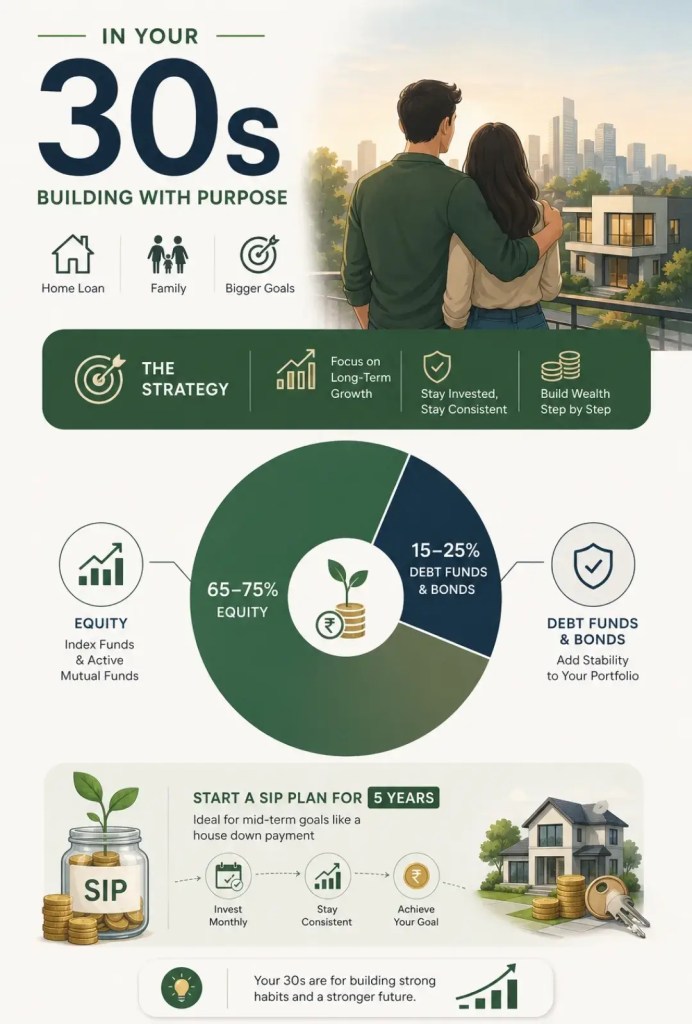
The Strategy: Focus heavily on equities for long-term compounding.
- 65–75% equity, split between index funds and actively managed mutual funds
- Start layering in some debt funds or bonds for stability
This is a good decade to explore a best sip plan for 5 years if you’re saving toward a mid-term goal like a house down payment
In Your 40s: Balancing Growth and Protection
You’re likely earning more, but you also have less runway before retirement than you did at 25.

The Strategy: A steady balance between high-return equities and stable debt instruments.
- 50–60% equity, leaning toward large-cap and index funds over small-caps
- Increase bond and debt fund allocation
- Gold ETF as a small hedge (5–10%) becomes worth considering here
In Your 50s and Beyond: Protecting What You’ve Built
The priority quietly shifts from “grow it” to “don’t lose it.”

The Strategy: High safety, capital protection, and regular income generation
- 30–45% equity, mostly stable, dividend-paying large companies
- Larger allocation to bonds, debt mutual funds, and fixed income
- Gold and REITs for income and stability
- Less appetite for anything speculative like sector ETFs
Investment Guide: How to Know Your Risk Tolerance Matching Risk Tolerance
Age is a guide, not a rulebook. Your actual risk tolerance — how you genuinely feel watching your portfolio drop 20% — matters just as much.
- Conservative investor: Prioritizes bonds, gold, large-cap mutual funds, minimal individual stock exposure, regardless of age
- Moderate investor: Balanced mix of index funds, diversified mutual funds, some bonds
- Aggressive investor: Heavier in stocks, sector ETFs, small-cap funds, comfortable riding out volatility for higher long-term returns
If share market live price swings genuinely stress you out, you’re probably more conservative than your age suggests — and that’s completely fine to plan around.
Common Mistakes I See Beginners Make
- Chasing whatever “best stocks to buy today” list is trending without understanding the company
- Ignoring a stock screener and picking stocks purely on tips from friends or social media
- Treating sip investment like a lottery ticket instead of a long-term habit
- Panic-selling during a dip instead of remembering their original time horizon
- Never rebalancing: An aggressive 25-year-old portfolio left untouched for 20 years is now, by default, a risky 45-year-old portfolio
Secret SIP Cheat code
You don’t need millions of rupees to start investing in the share bazar. That’s where a Systematic Investment Plan (SIP) comes in.

A sip investment lets you put small, fixed amounts (even ₹500 every month) into a sip mutual fund automatically. Instead of worrying whether the stock market today open high or low, or constantly checking the share market today, an SIP averages out your buying costs over time.
How an SIP Works Over Time:
Month 1: Market High => You buy fewer units 📉
Month 2: Market Drops => You buy MORE units 📈
Month 3: Market Rises => Your total average cost stays balanced! ✨
How to Invest in Share Market
If you are eager to explore the indian stock market or start your journey, here are three quick steps to follow:
- Educate Yourself First: Use reliable stock market websites and tools to track market data, read stock analysis, and observe how gold stock price or global trends like the us stock market live affect local indices.
- Consult Certified Experts: Before making large financial commitments, speak with SEBI-registered financial advisors who can tailor mutual funds investment plans specifically for your goals.
- Start Small and Stay Disciplined: Open an account on a best trading platform in india with adult supervision if you’re under 18, and build a consistent investing habit.
Investing isn’t a race to get rich overnight—it’s a long, exciting marathon. By understanding your age, knowing your risk tolerance, and picking the right squad of assets, you set yourself up for lifetime financial freedom!
FAQs
Affiliate Disclosure: Some of the blogs may contain affiliate links. If you purchase through these links, we may earn a small commission at no extra cost to you. This helps us continue providing valuable knowledge and free content through our blogs.

I am a pharmacist , investor, tech savvy and multi-niche content writer with over 5 years of experience and have served more than 15 organisations.
Join CompareWise on WhatsApp
Stock trends, AI workflow breakdowns & smart comparisons directly on your phone.